



True calm isn’t created by cushions; it’s created by connection” PDA parenting
Connected Needs
Connected Needs
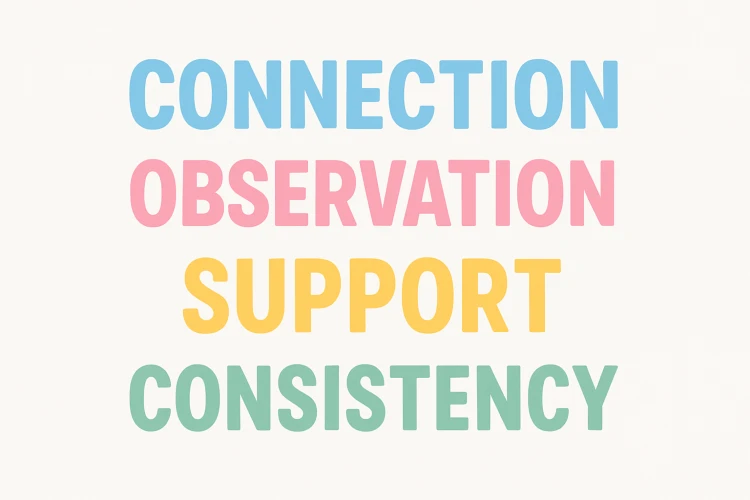
Connection, Observation, Support, and Consistency
Our Connected Needs Workshops equip practitioners, leaders, and managers with the knowledge, skills, and confidence to build meaningful connections with children and colleagues who require additional support. The training empowers participants to develop and implement effective strategies that promote understanding, inclusion, and wellbeing.
At the heart of our approach is the COSC model — Connection, Observation, Support, and Consistency — a guiding framework that underpins all our Connected Needs training sessions.
Our trainings can also be designed specifically to meet the training needs of your teams or individuals and can be delivered online or in person.
Schematic Play Training
Understanding the Importance of Schematic Play Training in Early Years
Schematic Play Training is a valuable approach for an Early Years Facilitator, as it deepens understanding of the natural learning patterns children display through play. By recognising common schemas such as transporting, enveloping, trajectory, and rotation, practitioners can plan purposeful activities that nurture curiosity, problem-solving, and early cognitive development.
Through Schematic Play Training, Early Years Facilitators gain practical strategies to observe, interpret, and extend children’s play, creating environments that support holistic learning and align with the Early Years Foundation Stage (EYFS). This professional development not only enhances practice but also strengthens engagement with families, as practitioners can clearly explain the significance of play behaviours and how they contribute to a child’s growth and learning journey.

Outline of training
Within our training sessions participants will:
- Engage in interactive activities
- Enhance knowledge in all “needs” related to children and young people.
- Update practise in relation to Trauma, Child Protection and Adult Protection.
- Feel confident in developing and recording strategies to support the needs of children and young people.

Becoming a Behaviour Detective
Outline of Training
Behaviour is a form of communication. In this workshop, we explore the possible messages a child may be trying to convey through their behaviour.
The session will highlight:
- The importance of our environments
- The impact adults can have on children’s behaviour
- How to use this understanding to develop effective support strategies
Who Should Attend:
All practitioners, leaders, and managers working with adults and children who require support, particularly where there is no formal diagnosis.

Trauma-Informed Practise
Outline of Training
This session will help participants:
- Recognise the 5 Rs that underpin trauma-informed practice
- Understand trauma through a trauma lens
- Identify the impact trauma can have on children’s development
- Promote trauma-informed practice by being a trauma-informed practitioner
Who Should Attend:
All levels of practitioners. This course meets the SSSC requirement for mandatory training in Scotland.

The Parent’s Journey
Outline of Training
This reflective session explores:
- How to support parents when a child’s development presents differently
- A parent’s journey from birth through to the school transition
- The importance of practitioner communication and connection with families
- The relationship between managers and parents
- The influence other families can have on a family with a child with additional needs
Who Should Attend:
All levels of practitioners. This session reinforces the importance of connection and communication with families.

Supporting Neurodiverse Practitioners
Outline of Training
This session explores and identifies:
- Definitions and characteristics of neurodiversity
- Common challenges neurodiverse practitioners may experience in early years settings
- Practical strategies for support and inclusion
Focus areas include Dyslexia, Dyspraxia, Dyscalculia, Autism, and ADHD.
Who Should Attend:
Managers, leaders, and owners who support neurodiverse staff to build a sense of belonging and well-being within their teams.

Supporting Children with English as an Additional Language (EAL)
Outline of Training
This training explores:
- Creating inclusive environments for EAL learners
- Effective strategies to support EAL development
- Embracing cultural, religious, and racial diversity
- The pivotal role of the practitioner
Who Should Attend:
All levels of practitioners.

An introduction to Child and Adult Safeguarding and Protection
Outline of Training
This training explores:
- Recognise Signs and Symptoms of abuse
- Defining Child and Adult Protection and Safeguarding.
- Responding to an allegation
- Raising awareness of online abuse and how to respond.
- Being aware of Policies in relation to Child and Adult Protection.
- Feeling confident in all aspects of Child and Adult Protection.
Who Should Attend:
This training is for practitioners that need to renew or update their Child & Adult Protection training
This training can be delivered online or in person and is two separate trainings. One for Child Safeguarding and protection and the other for Adult Safeguarding and protection.

